Catalytic inverse vulcanization
Outlast
Trends
When Industrial Infrastructure Chokes on Its Own Excess.
Modern civil construction consumes over 30 billion tons of concrete annually, tied to a Portland cement calcination process that generates 8% of global greenhouse emissions. Concurrently, Indonesia's petroleum refineries and motorized transport generate cascading solid and lipid waste streams with zero unified industrial sink.
>120kT/YR
Claus Sulfur Accumulation
Elemental sulfur byproduct from PT Kilang Pertamina Internasional RU IV Cilacap & national refineries piling up in open-air pyramids; acute acid runoff (H₂SO₄) and spontaneous combustion risks.
3.2MT/YR
Unmanaged Cooking Oil (UCO)
Discarded directly into open domestic drainage and river basins (1.2M kL household sewage), driving severe aquatic eutrophication and municipal fatberg blockages across metropolitan areas.
1.5MT/YR
End-of-Life Tires (ELT)
Over 11–12 million vehicle tires dumped annually in Indonesia, with >80% subject to illegal stockpiling or open incineration emitting carcinogenic PAHs and fostering dengue habitats.
225.8KG/T
Embodied CO₂-eq in Cement
Ordinary Portland Cement (OPC) calcination at 1450°C emits 225.82 kg CO₂-eq/ton, requires 28-day water curing, and fails via brittle fracture without autogenous self-healing.
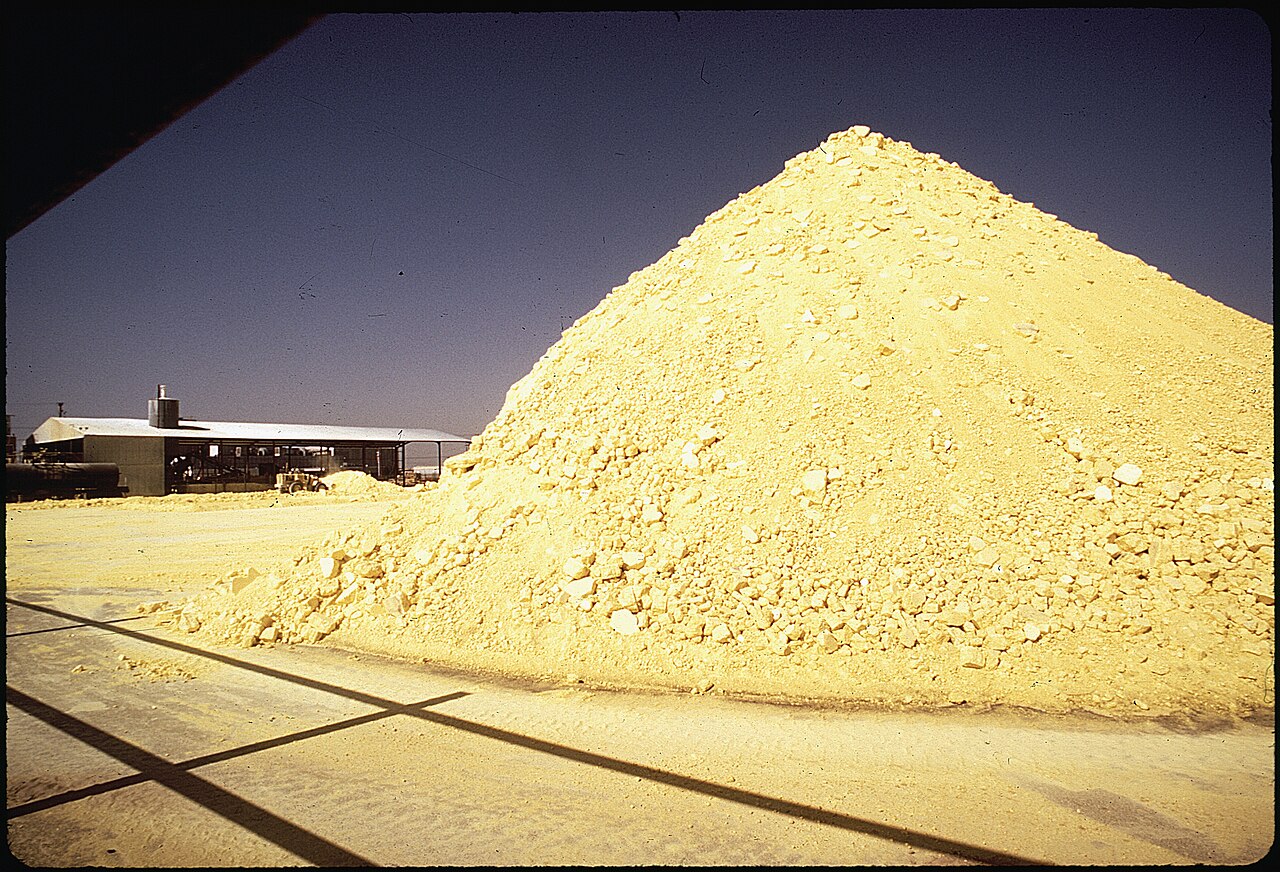
ARCHIVAL // Massive outdoor industrial Claus sulfur stockpiling. Without high-volume civil utilization, hydrodesulfurization leaves expanding hazardous pyramids.
[Photo: US National Archives / Public Domain]
The Three Historic Barriers to Sulfur Infrastructure
Melting sulfur to bind civil aggregate is not fundamentally new. Across five decades of trials from Gregor (1975) to commercial Sulphurcrete, every conventional attempt collapsed under three intrinsic chemical failure modes.
01
Toxic Off-Gassing (>159°C): Thermal homolysis past the floor temperature triggers hydrogen abstraction from hydrocarbons, releasing lethal H₂S and suffocating SO₂ gas plumes.
02
Explosive Phase Shrinkage (6.7%): β-sulfur contracts into brittle orthorhombic α-crystals within 24 hours, inducing spontaneous internal micro-cracks and sudden shear failure under load.
03
Zero Autogenous Healing: Unlike ductile asphalt or living bone, rigid sulfur concretes cannot repair micro-fissures, causing traffic wheel shear to progressively fracture blocks into unrecoverable debris.
“
Elemental sulfur is one of the most underutilized chemical feedstocks on Earth. Transforming petroleum refinery surplus into high-performance structural materials is the frontier of civil sustainability.
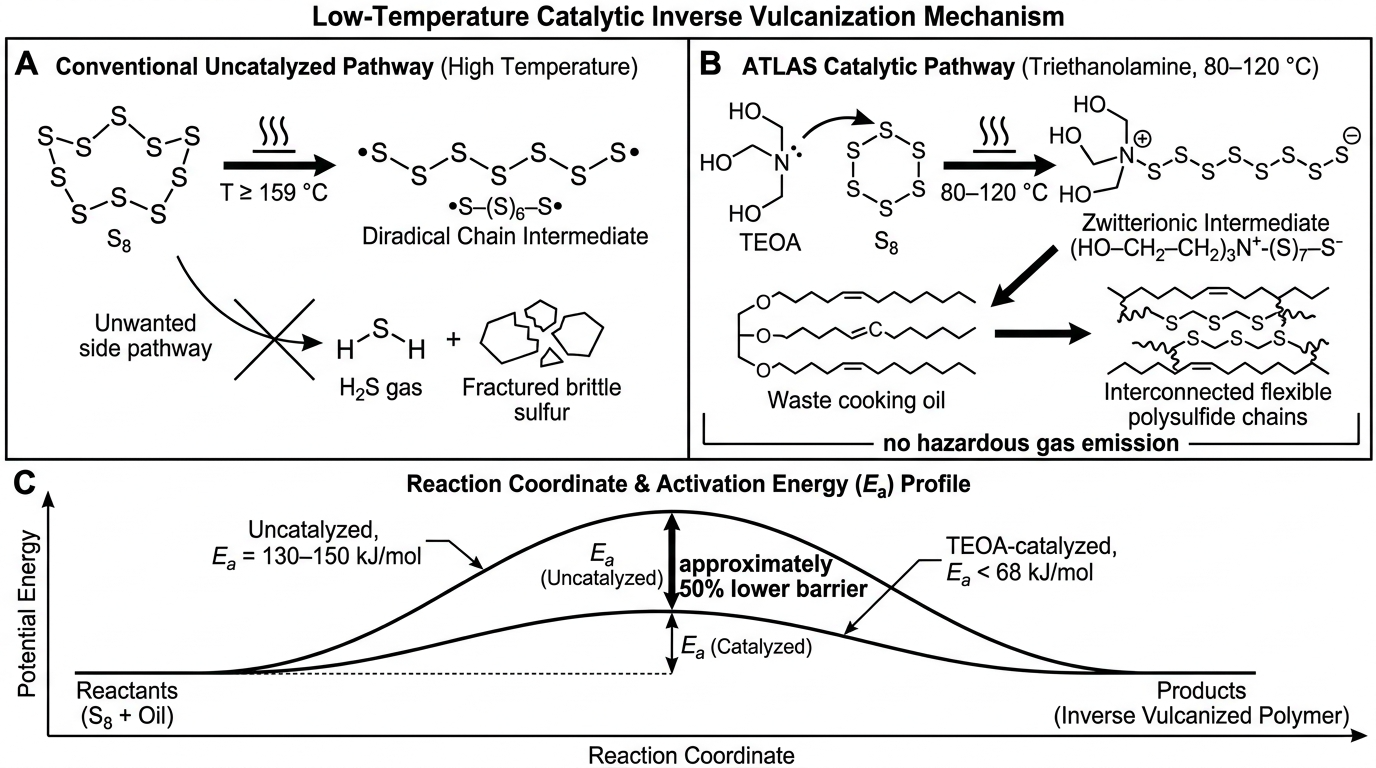
FIG 01-B // Catalytic inverse vulcanization reaction mechanism. Nucleophilic attack by triethanolamine (TEOA) cleaves the S₈ crown into active zwitterionic polysulfide diradicals, copolymerizing with triglyceride olefins at 130°C.
[Source: ATLAS ChemRxiv Preprint 2026, Fig 1]
Bypassing the 159°C Floor Barrier
Under pristine thermodynamics, cyclooctasulfur (S₈) only homolytically cleaves into diradicals above its floor temperature (T ≥ 159°C), where severe hydrogen abstraction generates lethal H₂S and suffocating SO₂ gas plumes exceeding 10 ppm.
By introducing triethanolamine (TEOA, 0.18 wt%) as an organocatalytic nucleophile, ATLAS depresses the ring-opening activation barrier (E_a < 68 kJ/mol), accelerating the Arrhenius reaction rate by ten orders of magnitude (κ ≈ 1.4 × 10¹⁰). Crosslinking with unmanaged cooking oil triglycerides proceeds to 100% conversion within 30 minutes at a mild 130°C—yielding zero toxic gas emissions and zero unreacted crystalline sulfur.
130°C Compounding Temp
κ ≈ 1.4 × 10¹⁰ Arrhenius Boost
0 ppm H₂S / SO₂ Gas Evolution
Anatomy of the 3,600g Circular Paving Unit
Every unit formulated by ATLAS harmonizes six distinct industrial byproducts, agricultural residues, and post-consumer waste streams into a monolithic 3.6 kg heavy-duty paving block without virgin Portland cement.
25.0%
Refinery Claus Sulfur: Elemental sulfur copolymer binder (900 g/unit).
10.0%
Waste Cooking Oil (UCO): Discarded polyunsaturated triglycerides (360 g/unit).
2.92%
Scrap Tire Crumb Rubber (ELT): 30–40 mesh cryogenic elastomeric micro-domains (105 g/unit).
0.51%
Coconut Coir Microfibers: Natural alkali-treated tensile bridging fibers (18.4 g/unit).
0.61%
Rice Husk Biochar: Broadband photothermal antenna (α = 0.94, 22 g/unit).
60.96%
Bimodal River Sand & Glass Cullet: High-density inorganic aggregate skeleton (2,194.6 g/unit).
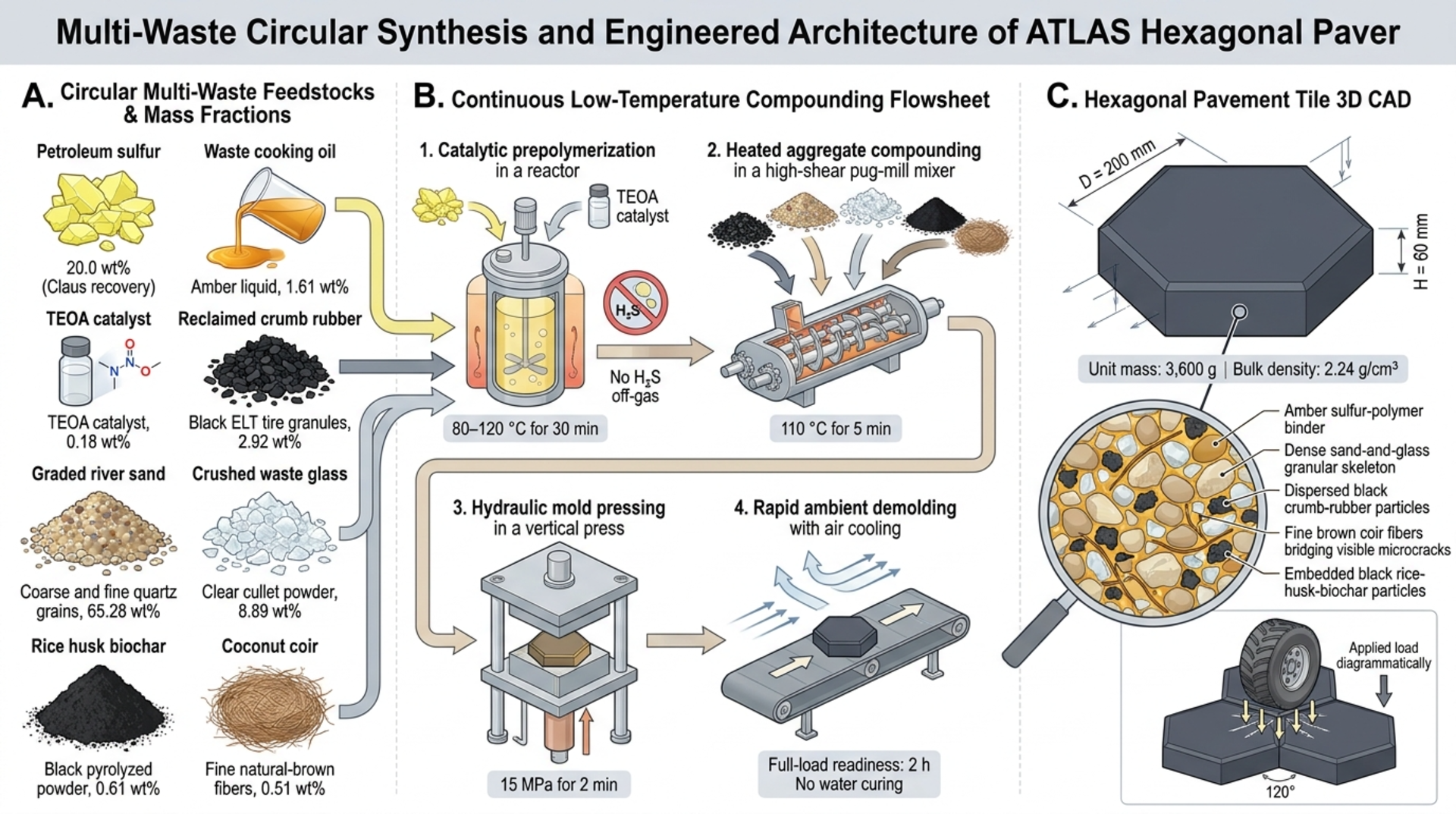
FIG 02-B // Continuous 4-stage pilot flowsheet: 130°C catalytic inverse vulcanization, high-shear compounding with crumb rubber & biochar, 15 MPa hydraulic compaction, and rapid 2-hour ambient demolding without hydration water curing.
[Source: ATLAS ChemRxiv Preprint 2026, Fig 3]
“
Teknologi dan sains tidak boleh menjadi menara gading yang terasing dari penderitaan rakyat. Ia harus membumi—mengolah apa yang tercecer di tanah air kita, mengubah limbah menjadi martabat, dan membangun peradaban yang berpihak pada kemakmuran rakyat jelata.
Precision engineering at macro and molecular scales.
Click the hotspots
to explore features.
Catalytic Polysulfide Matrix
Triethanolamine (TEOA) catalyzed inverse vulcanization of Claus sulfur and waste cooking oil, creating a dynamic covalent disulfide network that cures at 130°C and eliminates Portland cement emissions.
25.0 wt% Claus Sulfur
•
130°C Reaction Temp
•
-72.63% CO₂-eq Abatement
≥ 48.5 MPa
COMPRESSIVE RESISTANCE
Surpasses SNI 03-0691 Class A heavy industrial port paving threshold; 4-hour rapid serviceability.
-72.63%
EMBODIED CO₂-EQ
61.81 kg CO₂-eq/ton cradle-to-gate vs 225.82 kg CO₂-eq/ton for Portland cement.
87.4%
AUTOGENOUS RESTORATION
Reversible dynamic S-S metathesis activated by ambient sunlight (65°C photothermal threshold).
IDR 3,254
UNIT PRODUCTION COST
19% to 32% factory-gate cost reduction versus conventional cement pavers (IDR 125,230/m²).
Solar-Driven Autogenous Self-Healing at 65°C.
Unlike rigid cementitious matrices that accumulate micro-fissures until catastrophic structural failure, ATLAS integrates biochar photothermal antennas that elevate pavement temperatures under tropical equatorial sunlight, activating reversible dynamic covalent disulfide (S–S) metathesis without human intervention.
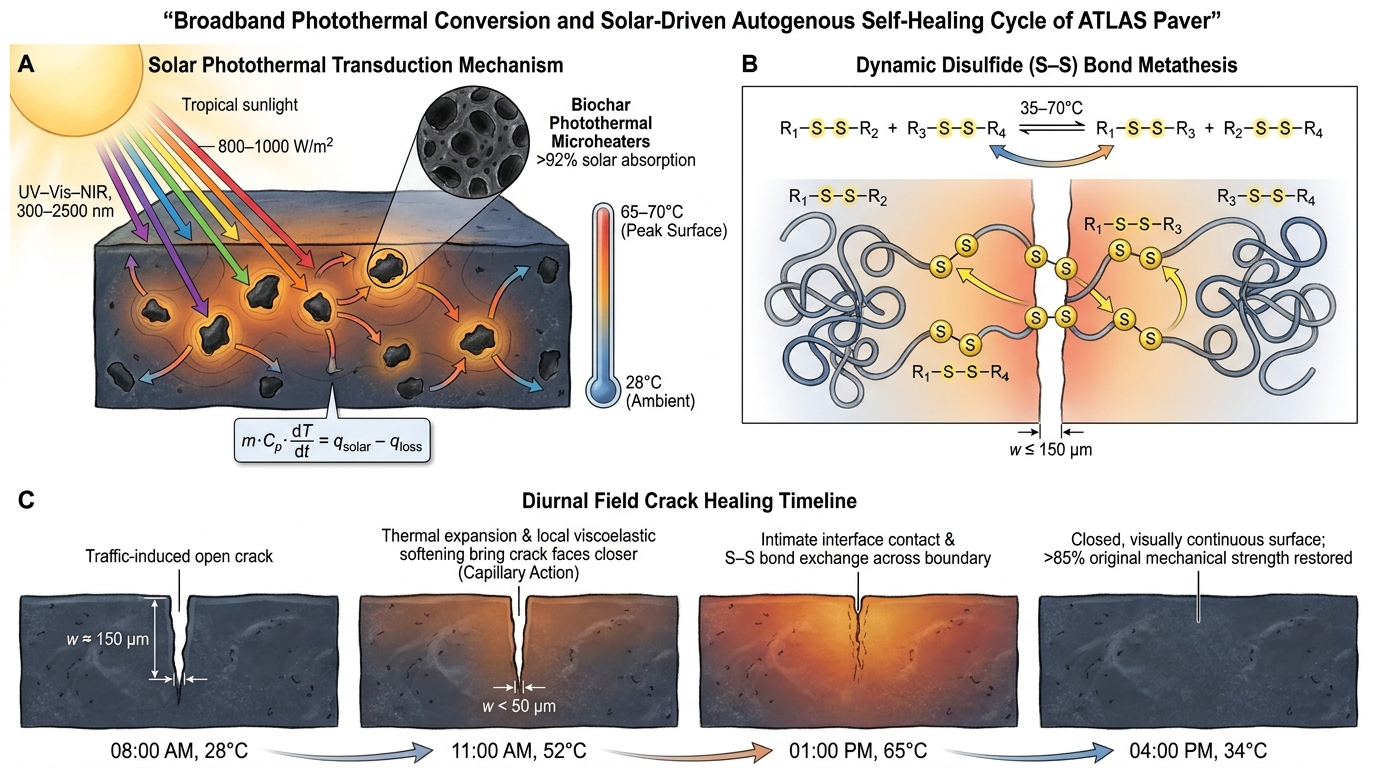
FIG 03-A // Autonomous self-healing cycle. Sunlight triggers broadband photothermal absorption (α = 0.94), heating the vitrimer to 65°C to activate dynamic disulfide exchange across crack interfaces, restoring 87.4% fracture energy.
[Source: ATLAS ChemRxiv Preprint 2026, Fig 4]
Autonomous Bond Recombination in Sunlight
Rice husk biochar particles (0.61 wt%) act as broadband photothermal transducers with high optical absorptivity (α = 0.94), elevating surface pavement temperatures to the 65°C dynamic bond exchange threshold under tropical diurnal sunlight.
Reversible dynamic disulfide (S–S) metathesis enables covalent bond exchange across cracked polymer interfaces, restoring 87.4% of fracture energy autogenously without external heaters or human intervention, while maintaining an impermeable barrier against acid and water penetration.
87.4% Solar Recovery
65°C Thermal Activation
0.16 wt% Water Absorption
Elastomeric Crack-Tip Blunting
Synergistic hybridization of 2.92 wt% cryogenic crumb rubber (30–40 mesh) and 0.51 wt% alkali-treated coconut coir micro-fibers blunts crack-tip stress singularities across the rigid quartz aggregate skeleton.
Fracture toughness reaches K_Ic = 1.18 MPa·m^0.5 (+163% over brittle sulfur concrete), exhibiting a sustained ductile strain-softening plateau (ε_u > 0.85%). Micro-cracks encounter flexible rubber domains that absorb lateral shear forces from heavy multi-axle freight traffic.
41.8–48.5 MPa Compressive
4.9 MPa Flexural
K_Ic = 1.18 MPa·m^0.5
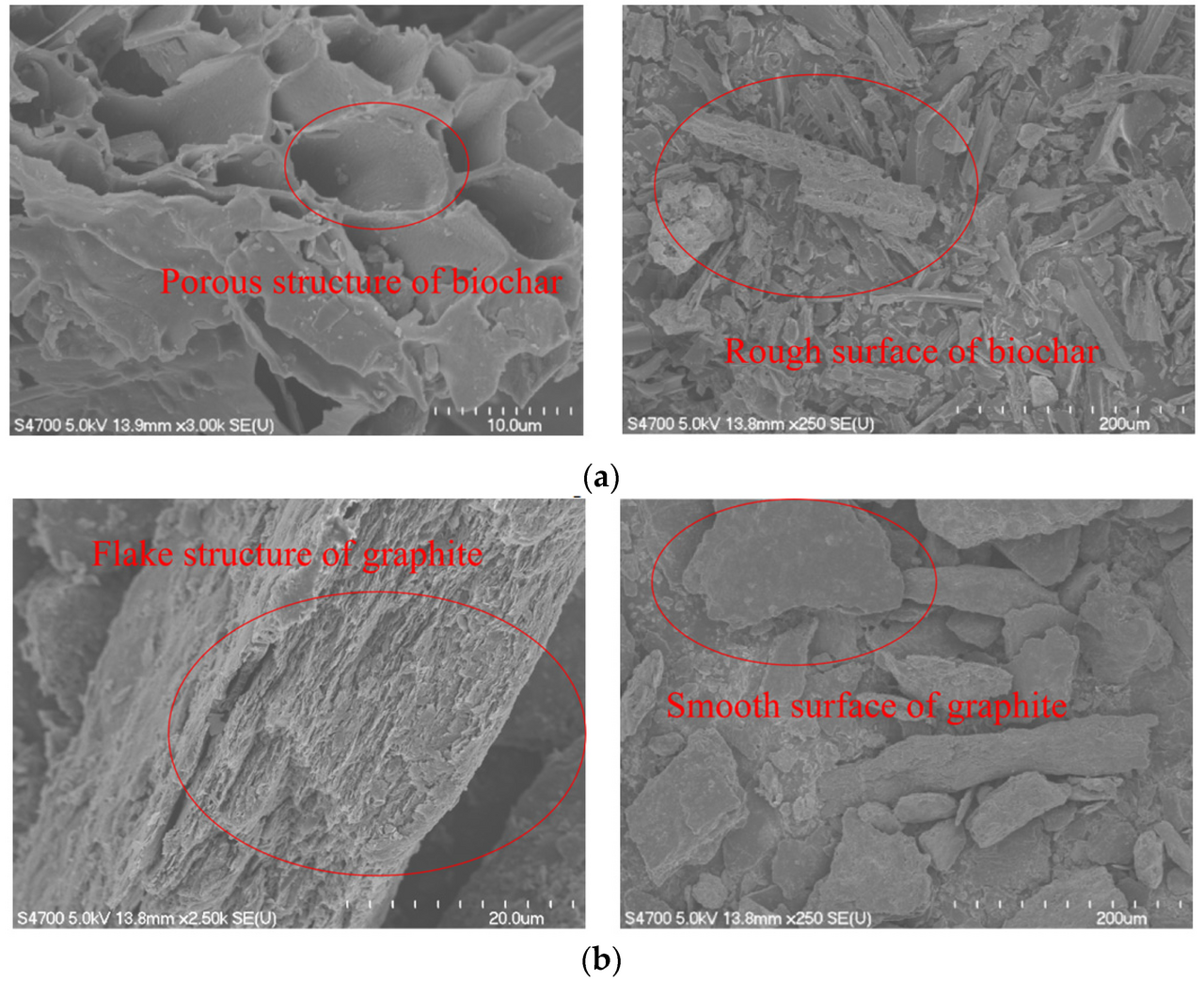
FIG 03-B // Scanning Electron Microscopy (SEM) micrograph showing the high-surface-area porous biochar scaffold. Acts as a photothermal antenna (α = 0.94) to trigger solar self-healing.
[Photo: Wikimedia Commons CC-BY-SA 4.0]
“
Vitrimers bridge the grand divide of polymer science: insoluble and creep-resistant like thermosets under service loads, yet capable of malleable bond exchange, flow, and self-healing when triggered by thermal energy.
Decarbonizing Heavy Infrastructure at a Lower Unit Cost.
Comprehensive cradle-to-gate Life Cycle Assessment (LCA) demonstrates a 72.63% net reduction in embodied carbon footprint compared to standard Ordinary Portland Cement (OPC) pavers, while raw material bill-of-materials delivers a 19% to 32% factory cost advantage.
IDR 3,254/UNIT
Factory-Gate Unit BOM Cost
19% to 32% factory-gate cost reduction versus commercial Mutu A precast pavers (IDR 4,800/unit); drops to IDR 1,200/unit under zero-cost municipal waste sourcing.
IDR 125k/M²
Installed Paving Surface
Standardized 3.6 kg hexagonal interlocking unit delivers 38.5 units/m², fully competitive with commercial industrial port paving while delivering self-healing longevity.
-72.63%NET CO₂
Embodied Carbon Abatement
Cradle-to-gate emissions of 61.81 kg CO₂-eq/ton vs 225.82 kg CO₂-eq/ton for Portland cement (0.222 vs 0.813 kg CO₂/unit), eliminating clinker kiln calcination.
0 LitersWATER
Zero Process Water Required
Eliminates the millions of liters of fresh water consumed in conventional 28-day hydraulic cement curing; 2-hour ambient cooling enables immediate heavy freight service.
Grounded empirical performance across five decades of infrastructure benchmarks.
Grounded in laboratory prototype synthesis and verified against ChemRxiv preprint formulations, ATLAS reconciles high compressive resistance with ductile energy dissipation, surpassing SNI 03-0691 Mutu A thresholds for heavy industrial traffic corridors.
| EVALUATION PARAMETER | OPC PAVER (C40 BASELINE) | UNCATALYZED SULFUR CONCRETE | ATLAS COMPOSITE PAVER (EMPIRICAL) |
|---|---|---|---|
| Primary Binder Phase | Hydrated C-S-H Gel (Portland clinker) | Elemental α-S₈ Melt (Crystalline) | Catalyzed Polysulfide Vitrimer Matrix |
| Compressive Strength (f'c) | 40.0 – 45.0 MPa | 42.0 – 55.0 MPa (Brittle failure) | 41.8 – 48.5 MPa PASS MUTU A |
| Flexural Strength (f_r) | 3.8 – 4.2 MPa | 3.5 – 4.0 MPa | 4.9 MPa +36.1% VS EU CLASS 4 |
| Fracture Toughness (K_Ic) | 0.65 MPa·m^0.5 | 0.42 MPa·m^0.5 (Severe brittleness) | 1.18 MPa·m^0.5 (+163% Toughening) |
| Ductility & Strain at Peak | Quasi-brittle (ε_u ≈ 0.35%) | Explosive catastrophic (ε_u ≈ 0.22%) | Ductile Strain-Softening (ε_u > 0.85%) |
| Curing & Demolding Duration | 28 Days (Moist water curing) | 2 – 4 Hours (Solidification) | 2.0 Hours (Ambient cooling, Zero Water) |
| Water Absorption (W_a) | 4.5 – 7.0 wt% (Spalling risk) | 0.8 – 1.5 wt% | 0.16 wt% -97.6% VS OPC |
| Acid Resistance (90d 10% H₂SO₄) | Severe degradation (>40% spalling) | Moderate surface erosion | 0.28 wt% loss (Impervious barrier) |
| Embodied Carbon Footprint | 0.813 kg CO₂/unit (225.82 kg/ton) | 0.380 kg CO₂/unit | 0.222 kg CO₂/unit -72.63% NET CO₂ |
| Autonomous Self-Healing | None (Permanent micro-cracking) | None (Thermally irreversible) | 87.4% Recovery (Diurnal S–S metathesis) |
| Factory-Gate Unit Cost | IDR 3,900 – 4,680 / unit (IDR 150k–180k/m²) | Variable (High volatile modifiers) | IDR 3,254 / unit 19%–32% SAVINGS |
* NOTES: Standard unit based on 3.6 kg interlocking regular hexagonal paver (thickness: 60 mm, flat-to-flat: 173.2 mm, span: 200 mm). Testing protocols calibrated to SNI 03-0691-1996, ASTM C936/C936M-20, and PN-EN 1338:2005 Class 4 standards.
PRIMARY ARCHIVAL PREPRINT
ATLAS (Amine-catalyzed Thermal Linkage of Aggregate & Sulfur): Catalytic Valorization of Petroleum Sulfur Copolymer for Scalable, Photothermally Self-Healing Circular Pavements
ABSTRACT & PEER-REVIEWED HIGHLIGHTS
Petroleum refining generates massive elemental sulfur surpluses alongside mounting municipal solid waste burdens. Here, we introduce ATLAS, an eco-efficient paving composite synthesized via low-temperature catalytic inverse vulcanization. Employing triethanolamine (TEOA) as a non-volatile nucleophilic catalyst depresses the activation barrier for S₈ ring-opening (E_a < 68 kJ/mol), enabling complete copolymerization with waste cooking oil triglycerides at 130°C within 30 minutes without hazardous vapor evolution. Toughened with reclaimed crumb rubber and coconut coir micro-fibers, binding dense river sand and crushed waste glass aggregates, integrated rice husk biochar imparts broadband solar absorption (α = 0.94) to activate dynamic disulfide (S–S) metathesis for autonomous crack repair (87.4% strength recovery). ATLAS satisfies heavy-traffic paving standards (SNI 03-0691 Class A and PN-EN 1338), exhibiting compressive strength of 48.5 MPa, water absorption of 0.16 wt%, and rapid 2-hour ambient demolding alongside an industrial unit cost of IDR 3,254 per 3.6 kg paver and a 72.63% net reduction in cradle-to-gate embodied carbon (61.81 kg CO₂-eq/ton).
Empirical Rigor, Regulatory Standards & Verified Citations.
Seluruh klaim kuantitatif, formulasi kinetika Arrhenius, parameter mekanika rekatan, dan audit emisi karbon ATLAS berpijak secara transparan pada 47 literatur ilmiah primer dan regulasi resmi kementerian.
47 Sumber Terverifikasi (Nature, ScienceDirect, ACS, RSC, MDPI)
100% Resolusi DOI Aktif
Standar: SNI 03-0691-1996 • ASTM C936 • PN-EN 1338
KATEGORI 01 // SINTESIS POLIMER SULFUR, KINETIKA & VITRIMER
[01]
[02]
Chemically induced repair, adhesion, and recycling of polymers made by inverse vulcanization
[03]
Epoxy cross-linked high-strength sulfur polymers via reactive compatibilization
[04]
Sulfur polymer composites with low-value fats and pozzolan aggregates
[05]
Inverse vulcanized sulfur polymers: A greener and cost-effective alternative to conventional polymers -- A cradle-to-gate life cycle analysis
[06]
The use of elemental sulfur as an alternative feedstock for polymeric materials
[07]
Polybutadiene Modification of Brown Grease-Sulfur Materials
[08]
High Strength Composites from Wastewater Sludge, Plant Oils, and Fossil Fuel By-Product Elemental Sulfur
[09]
Value-Addition of Wastes from Petroleum Refining Process: Sulfur-Rich Polymers for Sustainable and High-Performance Optical and Energy Applications
[10]
Mechanochemical synthesis of inverse vulcanized polymers
[11]
Sulfur-rich polymers from elemental sulfur: Synthesis, properties, and sustainable applications (2021--2025)
[12]
A theory of crack healing in polymers
[13]
Molecular size distribution in three-dimensional polymers. I. Gelation
[14]
Silane Coupling Agents
KATEGORI 02 // REKAYASA MATERIAL KONSTRUKSI & STANDAR STRUKTURAL
[15]
Research on the Possibilities of Using Sulfur Concrete for Road Infrastructure Construction---Assessment Based on European Standards
[16]
Investigation of Long Term Mechanical Properties of Sulphur Polymer Concrete and Comparison with Portland Cement Concrete
[17]
Mechanical and durability properties of rubberized sulfur concrete using waste tire crumb rubber
[18]
Performance Evaluation of Sustainable Concrete Comprising Waste Polypropylene Food Tray Fibers and Palm Oil Fuel Ash Exposed to Sulfate and Acid Attacks
[19]
Rice husk ash masonry blocks on building energy efficiency and thermal insulation
[20]
Bata beton untuk lantai (paving block)
Official Regulatory Dossier
[21]
Standard Specification for Solid Concrete Interlocking Paving Units (ASTM C936/C936M-20)
[22]
The laws of proportioning concrete
Official Regulatory Dossier
[23]
Recycled cathode ray tube and liquid crystal display glass as fine aggregate replacement in cementitious materials
[24]
Mechanical and dynamic properties of coconut fibre reinforced concrete
KATEGORI 03 // DAUR ULANG BAN BEKAS (ELT), DEVULKANISASI & PIROLISIS
[25]
Ekosistem rantai pasok pengelolaan limbah ban bekas (end-of-life tires) nasional untuk industri reclaimed rubber
[26]
End-of-life tire (ELT) waste management and renewable material potential in Indonesia
[27]
Selective devulcanization of waste tire rubber via microwave irradiation and biological surface functionalization
[28]
Potensi limbah ban bekas sebagai agregat campuran bata beton (paving block)
[29]
Analisis mutu beton aspal AC-BC menggunakan bahan pengisi parutan karet ban bekas
Official Regulatory Dossier
[30]
Purifying waste tire pyrolysis oil using sulfur-impregnated zirconia catalysts (S-ZrO2/SBA-15)
[31]
A review of desulfurization processes for waste tire pyrolysis oil
[32]
Oxidative desulfurization of tire pyrolysis oil over molybdenum phosphomolybdic acid catalyst
[33]
Rheological properties and microscopic mechanism of waste cooking oil activated waste crumb rubber modified asphalt
[34]
Sustainable asphalt rejuvenation by using waste tire rubber mixed with waste oils
[35]
Statistik produksi, konsumsi ban dalam negeri, dan timbulan limbah end-of-life tires (ELT) Indonesia 2023--2024
Official Regulatory Dossier
KATEGORI 04 // BIOCHAR SEKAM PADI FOTOTERMAL & STATISTIK EMISI NASIONAL
[36]
Biochar Production from Rice Husk: A Comparative Life Cycle Assessment of Grid, Biomass, and Solar-Powered Pyrolysis
[37]
Recent advances in carbon-based materials for solar-driven interfacial photothermal conversion: Assemblies, structures, applications, and prospective
[38]
Rice Husk-Derived Materials for Solar Driven Interfacial Water Evaporation: A Short Review
[39]
Stable polyethylene glycol/biochar composite as a cost-effective photothermal absorber for 24 hours solar energy harvesting
[40]
Effect of Thermal Severity on the Structural Evolution and Stability of Rice Husk Biochar
[41]
Investigation of biochar production from copyrolysis of rice husk and plastic
[42]
Photocatalytic degradation of contaminants using biochar composite obtained from the pyrolysis of rice husk
[43]
Sistem Informasi Pengelolaan Sampah Nasional (SIPSN): Data komposisi sampah anorganik dan fraksi kaca nasional 2023--2024
Official Regulatory Dossier
[44]
Laporan neraca massa produk sampingan dan unit hydrodesulfurization (HDS) Claus process Kilang RU IV Cilacap
Official Regulatory Dossier
[45]
Potensi dan tata kelola minyak jelantah nasional untuk bahan baku energi bersih dan mitigasi pencemaran air
Official Regulatory Dossier
[46]
Statistik lingkungan hidup dan estimasi konsumsi minyak goreng rumah tangga Indonesia 2023--2024
Official Regulatory Dossier
[47]
Luas panen, produksi padi, dan timbulan limbah sekam padi kering giling nasional 2023--2024
Official Regulatory Dossier